
Recognising cat flu: symptoms, spread and when to see a vet
Translated from our German original. Any rules and regulations mentioned refer to Germany and may differ where you live.
Is your cat sneezing all the time, with watery eyes and a runny nose? Those are typical cat flu symptoms. Cat flu is an umbrella term for contagious infections of the upper airways and the eyes. It is often mild, but it can also become serious enough to be dangerous, especially for kittens. Here you can find out how to recognise cat flu, how cats catch it, how to reduce the risk, and when you need to take your cat to the vet. A guide cannot replace a vet’s eye, and if you are unsure, jump straight to When your cat needs a vet.
What cat flu actually is
Several pathogens, one name
Cat flu is not a single disease. According to International Cat Care, more than 90 percent of these infections are caused by two viruses: feline herpesvirus (FHV-1) and feline calicivirus (FCV). Bacteria often join in. The MSD Veterinary Manual names Chlamydia felis and mycoplasmas alongside the two viruses, and the European expert group ABCD also includes the bacterium Bordetella bronchiseptica. A cat can be infected with several of these at once.
Why “flu” can be a misleading name
The everyday name sounds harmless. “Cat flu” suggests a mild cold. International Cat Care stresses that the illness varies widely in severity and can occasionally be life-threatening. The German veterinary industry association (BfT) makes the same point about the familiar name: it is usually not a harmless cold, but a serious, sometimes life-threatening infection.
Cat flu symptoms: how to recognise them
After infection, the first signs usually appear within two to six days, according to the MSD Veterinary Manual. The ABCD guideline on herpesvirus gives the same window, but notes that it can also take longer.
Early signs
Typical signs, according to the PDSA and International Cat Care, are:
- sneezing
- a nasal discharge, often clear at first
- watery, red eyes and frequent blinking
- lethargy
- a smaller appetite
- fever
Many cats eat less because a blocked nose means they can hardly smell their food, or because the throat and mouth are painful. If your cat is mainly much more tired than usual, our article on when a cat sleeps a lot can help you weigh that up.
When it gets more serious
Once bacteria join in, the discharge often turns purulent. Mouth ulcers, drooling, coughing, trouble swallowing and painful eyes are also possible. Herpesvirus can cause ulcers on the cornea, as both the ABCD guideline and the PDSA point out. Rarely, the infection spreads to the lungs.
Herpes or calicivirus?
Looks alone often cannot tell them apart, the MSD Veterinary Manual writes. There are tendencies, though. According to International Cat Care, herpesvirus tends to affect the eyes and nose and is often more severe. Calicivirus often causes ulcers on the tongue and can lead to temporary lameness in young kittens. Which pathogens are actually involved can be checked, if needed, with a swab from the throat, nose or eye, sent to a lab by your vet.
When your cat needs a vet
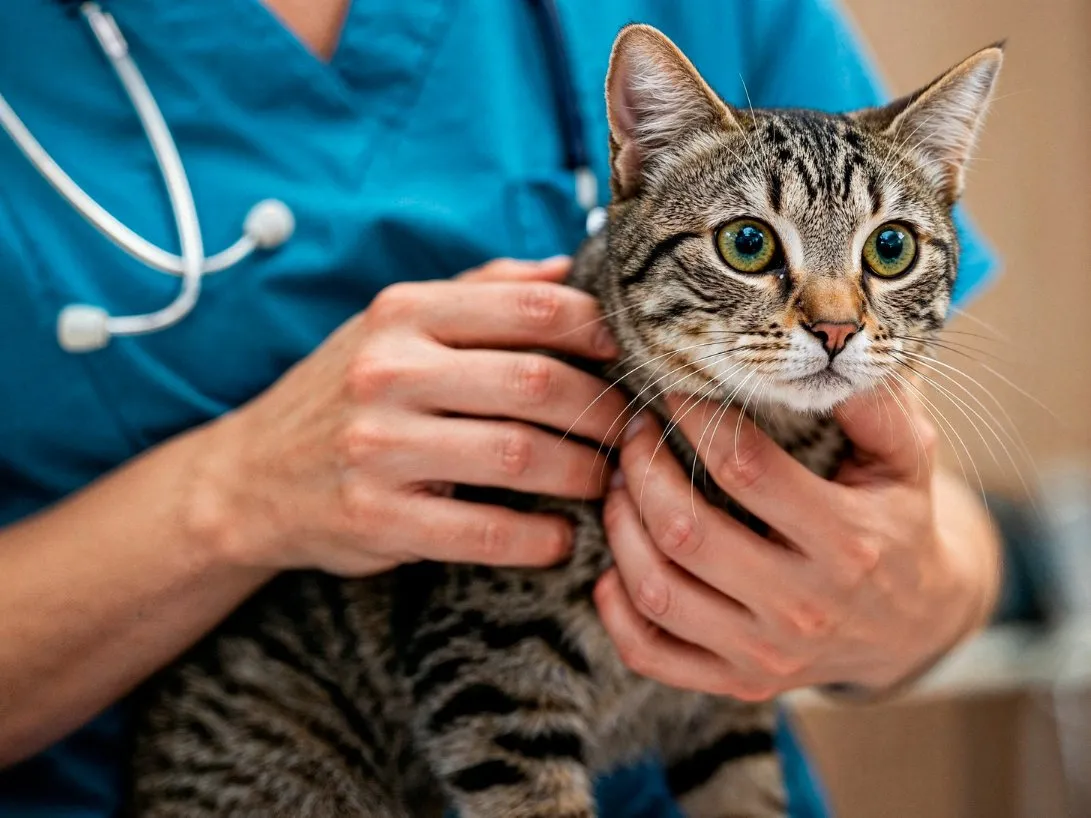
The basic rule: if your cat shows signs of cat flu, book an appointment at your vet practice. Both the PDSA and International Cat Care advise that. How quickly you should act depends on how your cat is doing.
Go now: the practice or emergency care
- Your cat is breathing with an open mouth, quickly, or with obvious effort. Cats normally breathe through the nose.
- The gums are pale, grey or bluish.
- Your cat collapses, barely responds, or can no longer stand.
- A very young kitten has symptoms and has stopped drinking or eating, seems floppy, or feels cold.
Serious breathing difficulty may need oxygen at the practice, the MSD Veterinary Manual for cat owners writes.
The same day
- Your cat has stopped eating altogether or is hardly drinking. Cats cope badly with going without food: according to International Cat Care, even a short time without nutrition can strain the liver. There is more in our guide on when a cat is not eating.
- Your cat is very lethargic and withdrawn.
- An eye is painful, swollen, cloudy, or held shut. Corneal ulcers need prompt treatment.
- The cat is a kitten, an older cat, or a cat with an existing illness. Kittens can deteriorate quickly, the PDSA says, and older cats or cats with a weakened immune system are more likely to become seriously ill, according to International Cat Care.
Check it soon
- Sneezing and discharge carry on or are not improving.
- The discharge turns yellow, green or bloody.
- You have several cats and one of them is ill.
- Your cat has had cat flu before and the signs are back.
Call the practice briefly before you go and say that your cat has flu symptoms. The PDSA advises waiting outside, so other cats in the waiting room do not catch it. How to make the visit less stressful is covered in our article on fear-free vet visits.
How cat flu spreads, including to indoor cats
The pathogens sit mainly in saliva and in nasal and eye secretions. According to International Cat Care, cats catch it in three ways: direct contact with a sick cat, contact with a carrier cat that sheds the virus without looking ill, and via objects such as bowls, blankets or clothing. The MSD Veterinary Manual also mentions droplets from sneezing and contaminated objects that people can carry from cat to cat.
Carrier cats are a big part of the story. Almost every cat that has been infected with herpesvirus carries it for life, according to ABCD. Stress, such as a house move, can reactivate it, with or without new signs. Many cats keep shedding calicivirus for weeks to months after the illness. Most of them clear it after a few months, International Cat Care says.
Indoor cats can get cat flu too. Their risk is lower than in shelters, breeding homes or large groups of cats, but it is not zero. Typical routes are a newly arrived cat, a stay in a cattery, a visit to the vet, or pathogens you bring home on your hands and clothes.

Can people catch cat flu?
For the two main viruses, the answer is no. ABCD reports no evidence that people can catch the herpesvirus, and it does not class calicivirus as a zoonosis either. The PDSA likewise writes that cat flu affects cats only.
Two of the bacteria involved have rare exceptions. Chlamydia felis has caused conjunctivitis in people in isolated cases, but the ABCD guideline on Chlamydia felis does not see a significant risk. Bordetella bronchiseptica is, according to ABCD, a rare possible zoonosis, and most cases involve people with a severely weakened immune system. If someone like that lives in your household, mention it at the vet practice.
And your dog? Herpesvirus does not jump to other species, ABCD says. Bordetella bronchiseptica, by contrast, is also a well-known cause of kennel cough in dogs. According to ABCD and the cat-vet association AAFP, cats can catch it from dogs with kennel cough.
Wash your hands thoroughly after contact with a sick cat, and avoid eye and nasal secretions, especially if your immune system is weakened. If you develop signs yourself, such as conjunctivitis, speak to your doctor.
Prevention: vaccination and hygiene
The most important protection is vaccination. Germany’s Standing Committee on Veterinary Vaccination at the Friedrich-Loeffler-Institut (StIKo Vet) classes the vaccines against herpesvirus and calicivirus as core vaccines. Every cat should be protected, including an indoor cat. The vaccine is usually combined with the one against feline panleukopenia.
A realistic expectation matters. Vaccination makes severe illness much less likely, but it does not prevent every infection. Against herpesvirus, StIKo Vet and ABCD say it does not stop a cat from becoming a carrier. Calicivirus has many strains, and vaccine protection is not always complete against all of them. Even a cat that has already had cat flu still benefits from vaccination, according to the PDSA and ABCD.
Your vet decides when and how often to vaccinate, matched to your cat’s age and the way she lives. Kittens receive a primary course of several appointments, followed by regular boosters, according to the StIKo Vet guideline. That is the German schedule; the exact appointments where you live are set by your own vet. Why vaccination matters in general is covered in our article on why vaccinations are vital for cats.
In a home with more than one cat, hygiene helps as well. International Cat Care recommends:
- keeping the sick cat in a room of her own
- her own bowls and her own litter box
- smooth, easy-to-clean surfaces in that room, rather than carpet and upholstery
- a suitable disinfectant, agreed with your vet practice
Washing your hands after every contact is part of it. A new cat is best kept apart from your other cats at first, and checked by a vet.
What you can do at home, and what you should not
Treatment depends on the pathogens and on how ill the cat is, and it belongs at the vet practice. There is no simple cure for the viruses themselves. According to International Cat Care, treatment is mainly about easing the signs. Depending on the case, that can include pain relief, eye drops, antibiotics for an added bacterial infection, and, in severe cases, antiviral medicines, fluids or a feeding tube. If your cat is prescribed tablets, our tips on how to give a cat a tablet can help.
At home, you can support your cat as the PDSA and International Cat Care describe:
- gently wipe the eyes and nose several times a day with a cotton pad moistened in warm water
- offer soft, strongly scented food, warmed slightly
- take your cat into a steamy bathroom if she is relaxed about it, so thick mucus loosens
- provide rest, warmth and as little stress as possible
What you should not do: do not give your cat medicines meant for people, including a decongestant nasal spray. Those drops can be toxic to cats, International Cat Care writes. Do not use leftover antibiotics on your own either, because antibiotics do not work against viruses. And do not force-feed a cat, for example with a syringe, because she can inhale the food. More on cat health is in our Health section.
Frequently asked questions about cat flu
What is cat flu?
Cat flu is an umbrella term for contagious infections of the upper airways and the eyes in cats. Feline herpesvirus and feline calicivirus are usually behind it, often together with bacteria such as Chlamydia felis, mycoplasmas or Bordetella bronchiseptica.
What are the symptoms of cat flu?
Typical cat flu symptoms are sneezing, discharge from the nose and eyes, red eyes, lethargy, a smaller appetite and fever. In more serious cases there can also be purulent discharge, ulcers in the mouth or on the cornea, and breathing problems.
Can people catch cat flu?
The two main viruses do not infect people. With the bacteria Chlamydia felis and Bordetella bronchiseptica, infection of people has been described very rarely, mainly when the immune system is weakened. Washing your hands thoroughly after contact with a sick cat still makes sense.
When should I take my cat to the vet?
Go straight away if there is breathing difficulty, open-mouth breathing, collapse, or a sick young kitten. If your cat has stopped eating, is very lethargic, or an eye is affected, go the same day. Mild signs that are not improving should be checked soon.
Does vaccination protect against cat flu?
The vaccines against herpesvirus and calicivirus are core vaccines for every cat, according to StIKo Vet in Germany. They make severe illness much less common, but they do not prevent every infection, and they do not stop a cat from carrying herpesvirus long term.
Can indoor cats get cat flu?
Yes. The risk is lower than for cats in large groups, but pathogens can reach the home via a new cat, a cattery, a vet visit, or hands, clothing and objects. An indoor cat should be vaccinated too.
How long does cat flu last?
Mild cases last about five to ten days, and severe ones up to six weeks, according to the MSD Veterinary Manual. With treatment, the signs often improve within one to two weeks, the PDSA says. Some cats keep lasting signs, or fall ill again when they are stressed.


