
Walking Your Dog in the Dark: Staying Safe and Visible After the Clocks Go Back
Translated from our German original. Any rules and regulations mentioned refer to Germany and may differ where you live.
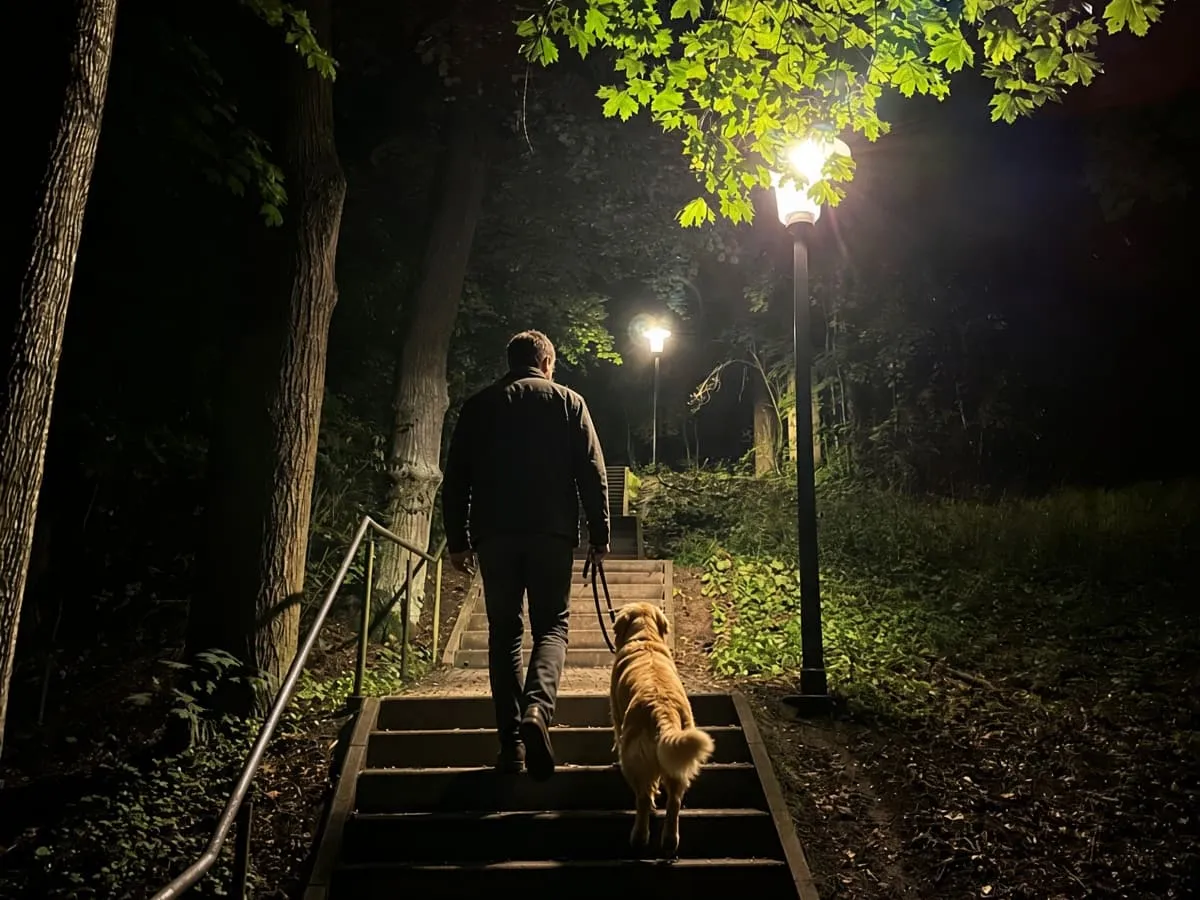
Walking your dog in the dark is part of everyday life again: since the clocks went back on 25 October 2026, it gets dark an hour earlier in the evening, and the after-work walk with your dog suddenly happens under streetlights. The short answer to staying safe: make sure you and your dog are easy to see, stick to routes you know and keep your dog on a short lead near roads and cycle paths. What matters most for your safety is that drivers spot you early enough. Here’s how to make that happen.
Why the dark season makes dog walks tricky
In the dark, you’re seen much later than you think. According to DGUV’s top eins magazine on visibility in traffic (in German), drivers only spot pedestrians in dark clothing in their headlights from about 25 metres away. Light-coloured clothing can almost double that distance, and clothing with retroreflective materials can be seen from around 140 metres.
Then there are the statistics: according to the German Road Safety Council (DVR) (in German), on average a third more pedestrians are involved in accidents from November to January than during the rest of the year. And your dog is smaller than you, with fur that’s hard to make out at night. Without any gear, your dog is even harder for others to spot.
A new rhythm after the clock change
The clock jumps, your dog doesn’t. Your dog knows nothing about summer and winter time and has their walk and meal times firmly in their head. In its tips on the winter clock change (in German), pet insurer Agria advises adjusting feeding times, walks and rest periods only gradually. By the way, in a survey by the insurer, 28 per cent of respondents said they never use reflectors in the dark. It’s also worth rethinking when the big walk happens: if you can, move it to your lunch break or the weekend and keep the evening walk shorter.
How to make your dog visible in the dark: light-up collars, reflectors, bright clothing
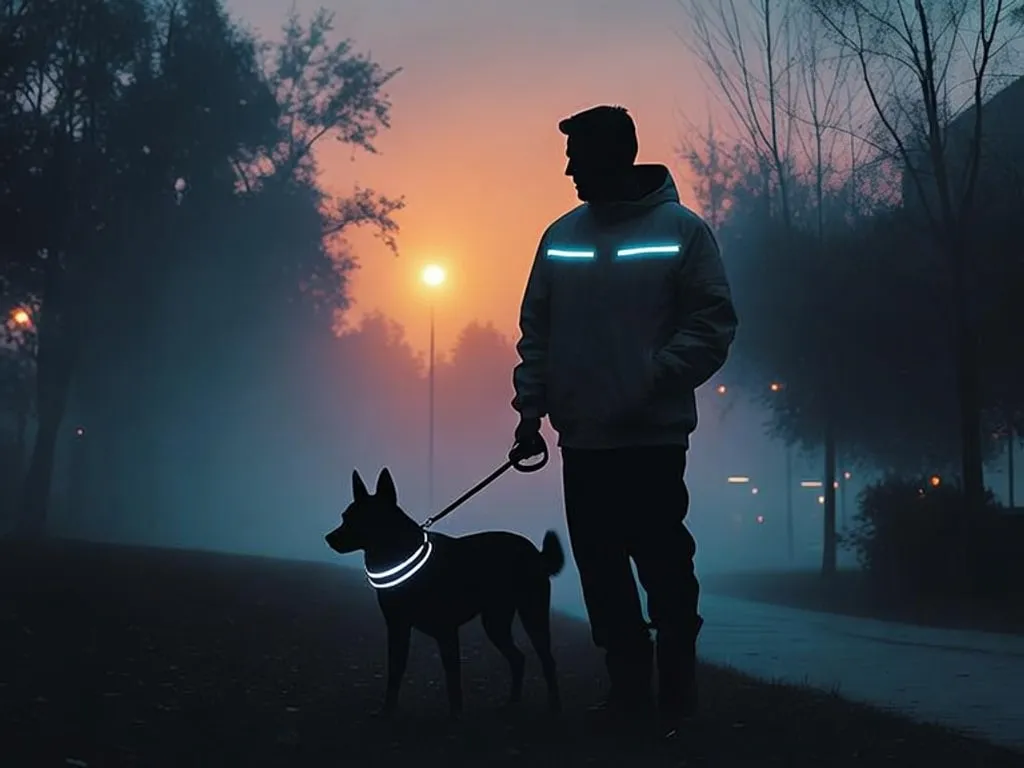
For others to notice you in time, you both need something that glows or reflects. Ideally, combine the two.
Reflective or light-up: the difference
| Reflective | Light-up | |
|---|---|---|
| How it works | bounces light back to its source, such as car headlights | LEDs glow on their own |
| When it works | only when light hits it | always, even without headlights |
| Who sees it | mainly drivers with their lights on | cyclists, pedestrians and you, too |
| What to watch | the material wears out | rechargeable or regular battery needs to be charged |
| Examples | reflective harness, bandana, lead with reflective strips | light-up collar, light-up harness, flashing light on the harness |
The DVR (in German) explains that retroreflective materials bounce light straight back to where it came from. On a dark country path with no light source, that doesn’t do much. A light-up collar, on the other hand, also helps you see your dog when they’re sniffing a few metres ahead.
Light-up collar, light-up harness or vest?
The right gear depends on your dog. These buying criteria help you choose:
- All-round visibility: ADAC’s guide to light-up dog collars (in German) recommends wider, sturdier collars because they glow better. Reflective harnesses, vests and coats make a larger part of your dog visible.
- Suits the coat: on long-haired dogs, LEDs easily disappear in the fur. Special collars or an extra reflective bandana help here.
- Rechargeable or battery: there are models with batteries and models that charge via USB. Go for whatever you’ll actually charge or replace regularly.
- Weatherproof: wet grass, rain, puddles – the light needs to handle all of that. Check the manufacturer’s information on water resistance.
- Easy on the eyes: according to the TASSO knowledge portal (in German), flashing lights can irritate some dogs. That’s why small clip-on lights are best attached on the back.
- Comfortable fit: a harness shouldn’t rub or restrict your dog. A sturdy harness also stops a startled dog from wriggling out of it, according to Agria’s tips.
- Durable: reflectors wear out, especially through rain and frequent washing. So check them regularly.
Dog trainer Sabine Winkler points out in Thieme Vet-News (in German) that light-up collars, hi-vis vests and reflective harnesses unfortunately can’t be seen from every angle. So it’s better to combine two things, for example a light-up collar plus a reflective harness. For everything else that belongs in the basic kit, see our beginner’s guide for new dog owners.
You need to be seen, too
Your dog can sparkle all they like: if you’re out in a dark parka, a driver might only see a glowing band that seems to float along by itself. According to DGUV top eins (in German), reflective bands on your arms and legs give you all-round visibility, because movement in particular catches the eye. When buying, look for tested products: the standard for reflective leisure clothing and accessories is EN 17353, and for hi-vis vests it’s EN ISO 20471.
Take a torch or headlamp with you as well. According to TASSO, it helps you spot trip hazards, find what your dog left behind more easily and be seen better yourself. A headlamp isn’t exactly a fashion statement, but it keeps both hands free.
Safe routes and lead handling
Choose familiar, well-lit routes
The dark isn’t the right moment for exploring. Take routes you know, that are lit and don’t have much traffic. Save new routes for the weekend in daylight. For ideas on keeping your walks varied anyway, check out our post on enjoying dog walks.
Short lead instead of a retractable one: safer for everyone
Hardly anyone can see a long or thin lead in the dark. According to ADAC, there shouldn’t be a trip hazard between dog and owner, and a lead with reflective strips is easier for others to spot. Sabine Winkler also warns that pedestrians or cyclists can trip over a long lead. On top of that, if a deer suddenly jumps out of the bushes, you’ll have your dog back at your side much faster on a short lead. So our tip: by roads, on cycle paths and anywhere other people are out and about, use the short lead.
Where your dog should walk
Under Section 25(1) of the German Road Traffic Regulations (StVO) (in German), pedestrians must use pavements. You may only walk on the road if there is neither a pavement nor a verge or hard shoulder. Outside built-up areas, you then walk on the left-hand edge of the road, where reasonable, and in the dark in single file rather than side by side. On the left-hand edge, you can see oncoming traffic. Walk your dog on the side facing away from traffic. When a car or bike approaches, your dog should be walking next to you and facing forward by then at the latest, according to Thieme Vet-News, so the light band and reflectors face the drivers.
Watch out for wildlife and traffic
Around the clock change, rush hour falls right at dusk, when wild animals are out looking for food. That’s why ADAC warns of more wildlife accidents in a press release on the clock change (in German): according to the German Insurance Association (GDV), there were around 276,000 wildlife collisions involving cars in 2024. The German Hunting Association (in German) names the morning and evening hours and the edges between woods and fields as especially dangerous.
What that means for you: your dog often smells and sees wildlife before you do. According to ADAC, dogs pick up movement at a great distance at dusk much better than humans, which makes their reactions hard to predict. One leap into the bushes can end badly on a country road – for your dog, the wildlife and the traffic.
The animals in the woods need their rest right now, too. In its position paper on lead requirements (PDF, in German), the German Animal Welfare Federation writes that wild animals need to save energy in autumn and especially in winter, and that dog owners should stay on the paths in the woods. Whether and where dogs must be kept on a lead is regulated differently by Germany’s federal states and municipalities. If in doubt, ask your town or municipality. In addition, according to the German Hunting Association, many driven hunts (in German) take place from October to January. Take signs like “Vorsicht Jagd” (caution, hunt in progress) or barrier tape along the path seriously.
When your dog is scared of the dark or won’t go out
Does your usually relaxed dog suddenly bark at the bins in the evening? You’re not alone. According to Sabine Winkler, many dogs are more insecure or alert in the dark. Some puppies born in summer are even scared during their first winter, though more of headlights and reflections than of the darkness itself. This usually gets better with time. Until then, twilight and quiet routes with little traffic help.
Watch your dog’s signals: a tucked tail, ears pinned back, panting or freezing. Our post on dog body language explains how to read them. Don’t force your dog through the situation. The Merck Veterinary Manual on behaviour modification in dogs describes how dogs do better getting to know what scares them in small steps (desensitisation), ideally combined with something positive like treats (counterconditioning). Punishment, on the other hand, can increase fear.
If an adult dog suddenly becomes anxious for no obvious reason, a health problem could be behind it, according to Thieme Vet-News. And if your dog hesitates in the evening, bumps into things or no longer wants to go into dark rooms, it may be a sign of failing eyesight. Cornell University on progressive retinal atrophy lists reluctance to go outside at night as a possible sign of this inherited eye disease. Either way: off to the vet.
Keeping busy when the walk is shorter
A shorter evening walk doesn’t mean your dog should be bored. Plan the longer walk and training for daylight, for example in your lunch break or at the weekend. Brain work is often just as tiring as running. A snuffle mat or little search games at home are perfect for dark evenings.
For more ideas for the cold season, see our 5 activities for your dog in winter. How much exercise your dog needs overall depends on age, breed and fitness. Our exercise plan for your four-legged friend helps you split the week sensibly.
Checklist for walking your dog in the dark
Quick check at the front door:
Frequently asked questions
Can dogs see in the dark?
Better than us, but not perfectly. According to a review on vision in dogs, dogs cope better than humans in low light but see details less sharply. They’re probably better than us at telling shades of grey apart, and perhaps at spotting movement.
Is a light-up collar enough on its own?
Usually not. A light-up collar can’t be seen from every angle and easily disappears in long fur. Combine it with a reflective harness, and remember that you need to be clearly visible, too.
Light-up collar or reflector: which is better?
Both have advantages: reflectors don’t need power but only work when light hits them. A light-up collar always glows as long as the battery lasts. Combining them is the safest option.
What should I do if my dog is scared of the dark?
Stay calm, choose short, familiar and well-lit routes and reward relaxed behaviour. Get your dog used to the dark in small steps. If the fear appears suddenly, have your dog checked by a vet.
Does my dog need to be on a lead in the dark?
In Germany, there’s no single rule: whether and where dogs must be kept on a lead is regulated differently by the federal states and municipalities. Regardless, your dog belongs on a lead by roads, on cycle paths and near wildlife unless they reliably come back every time.


